
Leaning into the commercial dashboard
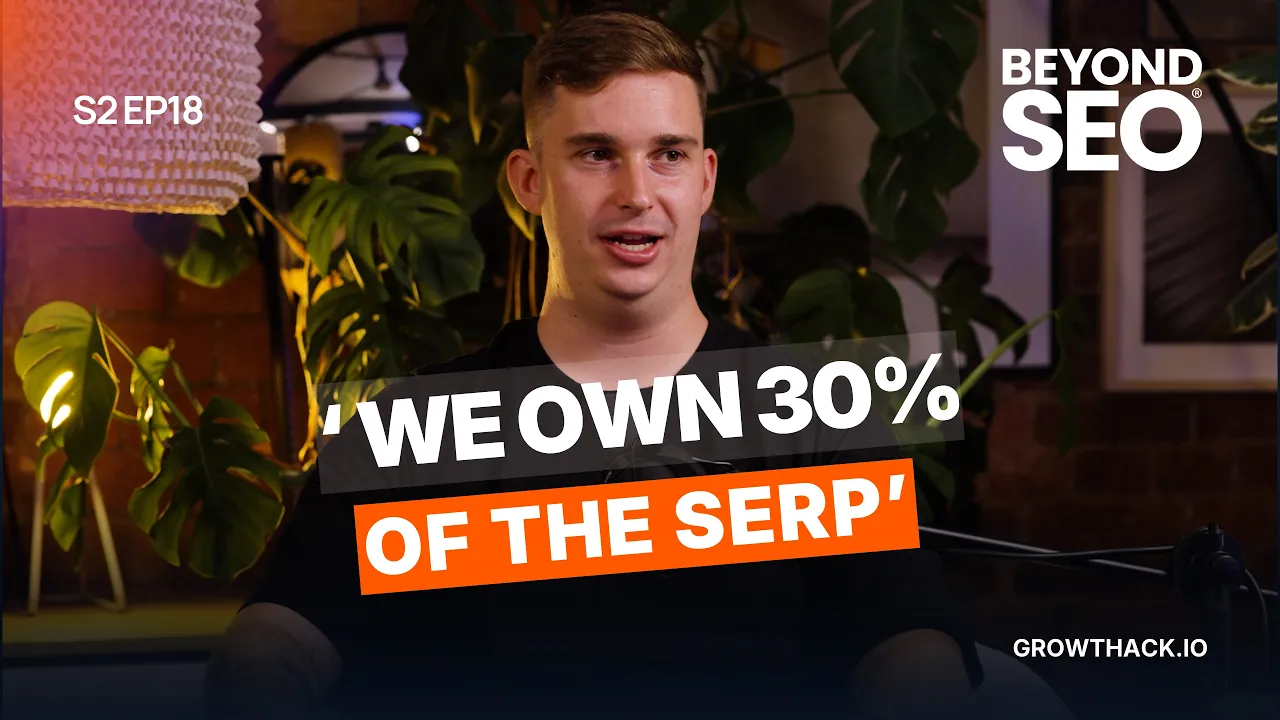
My conversation with Ryan Jones group marketing lead at the Advanced Interiors group, on Beyond SEO®.
Watch it now on YouTube: https://youtu.be/sEpQu2ob_E0
He has since gone to the opposite end of the job: in-house at a Sandiacre-based office fit-out group, running four websites, an email list of around 2,500 people, a brand new site build, and his own sales pipeline.
He is 27, has about a decade in marketing behind him, and has now worked at the same company twice. Six months back in, he has written just over £100,000 of revenue himself and I wanted to dive into the following:
Why would you deliberately run four websites instead of one?
What does a marketer do differently when they are also the client?
And how do you report on SEO when the average sale takes 77 days?
Four websites, and '30% of page one'
Every SEO is taught to consolidate: one domain, one set of authority. ACI does the opposite. The flagship site sits above a mezzanine floors site, a Unirack shelving site and an industrial partitions site, all one business entity, all treated as separate sites.
Then he described what that bought them. Two of the group's offerings, mezzanine floors and shelving, both answer the topic of optimising warehouse space. So he went after it from both sites.
"when you search warehouse shelving as the sort of topic keyword, we have 2 pages from our mezzanine company site that rank on page one, and another page from our shelving site that rank on page one"
"we now own 30% of that real estate"
Here is why that works, and it is worth knowing before you copy it. In June 2019 Google rolled out a site diversity change, and its own SearchLiaison account described it like this: "This site diversity change means that you usually won't see more than two listings from the same site in our top results", adding that it may still show more "in cases where our systems determine it's especially relevant to do so for a particular search" (as recorded by Search Engine Roundtable, 7 June 2019). Subdomains generally count towards their root domain.
So his two-plus-one result is not a fluke, and it is not something a single site could have produced. Two is the ceiling per site. The third listing exists because the third page is on a different domain.
The cost is his attention, which he named himself: four sites means deciding every month which one gets the time. He also will not push links from the strongest site into the weaker ones to force a ranking, only where it genuinely helps the reader, which is the discipline that keeps the whole thing from collapsing into a network.
Exact-match domains: tempted, untested
He keeps seeing a competitor rank for terms he wants with a purchased exact-match domain, then finds the parent entity behind it is the same company. ACI owns one itself, unirack.co.uk, because they distribute that shelving brand.
"I'll be honest, I've been tempted to try it"
His argument for testing is commercial, not SEO:
"we could be leaving money on the table if we didn't test it"
And the maths is different at high ticket. On a volume e-commerce business, payback on a domain plus a site plus the content takes a long time. On his:
"we had 5 inquiries from it and got 2 projects at £300,000, we've already paid back the investment"
His own caveat matters as much as the idea: "the exact match domain won't do everything." You still have to build the site properly. Test two or three terms, know exactly what the domain, the build and the hosting cost you, and compare that against what the site brings in.
Commercials first, marketing second
Ryan keeps two reporting dashboards and reviews both at the end of every month. One is a sales and quote tracker, built into a custom CMS that was in place long before he returned. The other is SEO performance. The order he opens them in is the interesting part.
"The commercial dashboard is the thing that I look at first and foremost, before I even open the marketing dashboard."
"I'm looking at the commercials first always."
Everything is tracked against quote requests, however the enquiry arrived: website form, phone call, recommendation. Call tracking tells them which of the group's sites a caller came from. So when one service gets a run of interest, that is what he writes about, emails about and spends his page-level time on for the next couple of months. When something slows down, he pulls back from marketing it.
This is the thing most SEO reporting is missing, and it is not a tooling problem. Agencies rarely get sight of the commercial dashboard, so they optimise against the only one they can see.
77 days, and one that took over 900
The day before we recorded, Ryan used Claude to build a lead-time view out of that CMS data, which records both the quote request date and the conversion date, and goes back to around 2010. Sixteen years of it.
An office fit-out averages 77 days from quote to sale. Their longest recorded lead time is over 900 days, which is nearly three years.
"I know that if a particular lead has come in and it's an office fit-out lead, I know that I probably can't really attribute it to the work that I'm doing for 3 months."
It cuts both ways, and he is cheerful about it:
"I can go into meetings right now and say that the work I did 3 months ago makes me a genius."
It also forecasts. A quiet month for quotes tells them, three months ahead of time, that revenue will dip. A strong quoting month tells them the opposite. If you only take one thing from the episode, he was explicit about which one it should be:
"the thing that I would always advise is to build that commercial dashboard"
Find the average lead time for every product and service you sell. Then you can work backwards from it, and justify where you are in an engagement instead of defending it.
The SEO who is also the client
The reason he can move this fast is that there is nobody to sell it to.
"in a technical sense, I am also the client"
"So I have to have those arguments almost with myself."
He gets a project to the point where the directors only need to say yes or no, and a lot of it needs no approval at all. My reaction on the day was that it sounds like a dream SEO job, and it is — but what makes it work is not the freedom. It is that he has been in-house before, so he already thinks in margins. He knows which of the group's services carry the highest margin, which is why office fit-outs, refurbishments and mezzanine floors are the three they push, and everything else is there to fill the gaps.
That commercial instinct is the thing he says is hardest to find in people who have only ever worked agency side.
Heat maps over SEO data
The new ACI site is not a migration. Same WordPress, no meaningful change to the page set, rebuilt on templates by page type, with the text reshaped page by page — including deleting text from pages that rank, which he calls a scary thing to do. The old site was heavy on copy. He wanted people to get down the page "without feeling like they're reading a novel almost".
The design was not decided on SEO grounds. They used Crazy Egg heat maps of the existing site to see what people clicked and what they ignored, then moved the ignored sections down rather than deleting them.
"I will take user heat maps and user ... data more often than I'll use any SEO data"
On whether it worked, he is careful, and he is right to be: the heat maps on the new site show people using it more the way they intended. That is a direction of travel, not a result. On a business this size he cannot get statistical significance in a fortnight, so he makes educated guesses and backs them with ten years of judgement.
Certain, likely, or guessing
The single most stealable thing in this episode is one line of custom instructions. Ryan asks Claude to label every answer:
"I ask it to label whether it's certain, likely, or guessing"
"having it tell me whether it's certain, likely, or guessing has been probably the biggest win"
It tells him when it is working from his own data and when it has gone off to a blog post it found. He uses AI heavily for trend analysis across a CMS he could never read by hand, and not for producing the content itself. His view is that it falls down when it has to draw its own conclusions, because that is when it starts importing things from outside the dataset.
My own experience is less patient than his. I said on the day that sometimes I spend half a day correcting it, and that I could have done the job manually quicker. Both things are true at once: it is excellent on a bounded dataset and expensive on an open question. The label trick is how you tell which one you are in.
Final Thoughts
Four things I am taking from this one:
Two page-one listings is the ceiling for one site, so a second domain is a legitimate strategy and not a trick
Open the commercial dashboard before the marketing one, every month
Know your average lead time per service, or you will keep defending work that has not had time to land
Make AI tell you how confident it is
The thing he would change about his own career is the same thing in a different shape. Not the jobs, the proximity: spend time with sales earlier, and bring the testing mindset in from day dot rather than learning it years later.
"one of my number one pieces of advice is to spend some time with the sales team"
You do not have to do the selling. Listen in on the calls.
Watch the full episode of Beyond SEO® with Ryan Jones of Advanced Commercial Interiors: https://youtu.be/sEpQu2ob_E0



" width="0px"/></svg>)