
The magic number
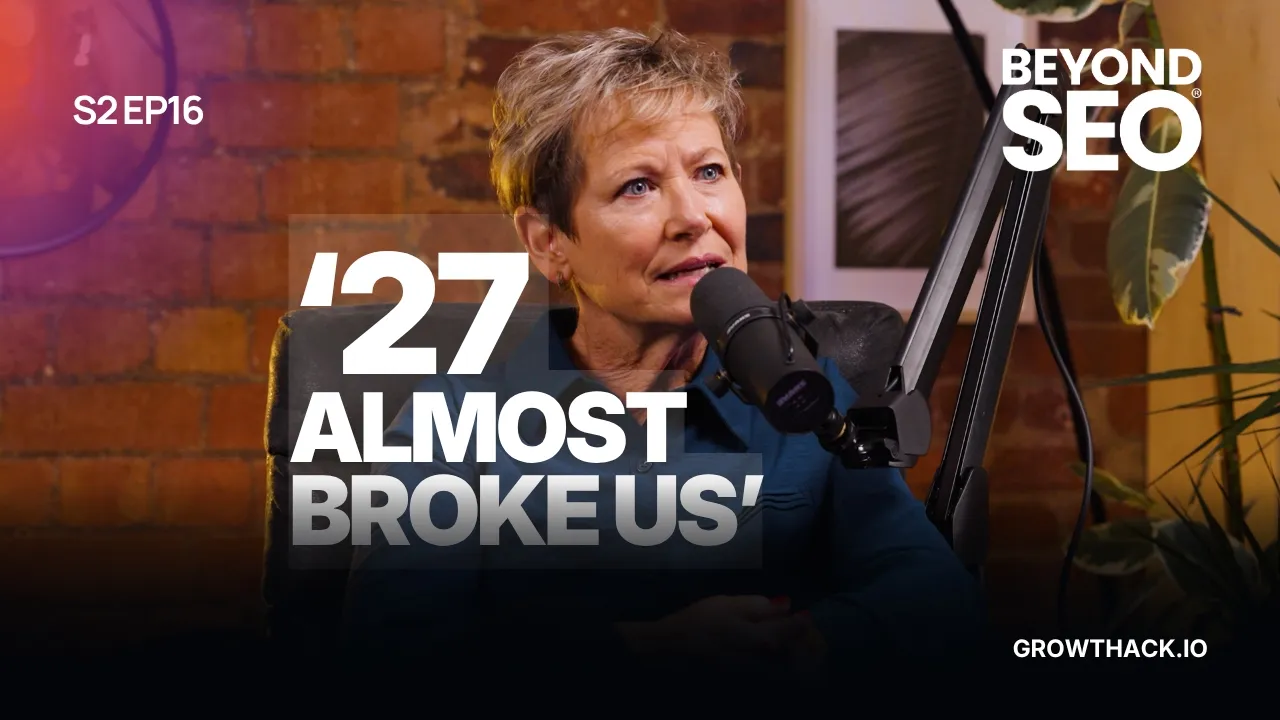
Part two of my conversation with Susan Hallam MBE on Beyond SEO®.
Watch it now on YouTube: https://youtu.be/hBG5UsOFS5c
Part one was the story of building her agency.
This one is all about the mechanics:
What breaks as an agency scales?
At what point does a founder make themselves redundant?
And what does the agency of the future look like?
This is the more uncomfortable half of the conversation, and the one you might find more useful.
The breakages arrive at specific sizes
The most useful thing here is that Susan can name the headcount at which each thing broke.
"I had to learn to trust those employees ... I've hired them for a reason. They're good at what they do." – Susan Hallam MBE, founder of Hallam
At 15 staff members it changed shape: "all of a sudden we had to find different ways of communicating with each other," which is when Slack arrived.
By 25 employees it had changed again, into process: "we need to be doing repeatable, scalable processes."
Then 27 employees
"The magic number, I don't know if you've heard the magic number that many agencies have a really hard time, 27 employees. They say that's ... a real tipping point, that if things are gonna go pear-shaped it's gonna happen when they're 27. Well, I'll put my hand up in the air and say that was a really hard time for Hallam."
So I went looking and I could not find a source.
No published research, no dataset, no study names "27 employees" as an agency failure point. The closest was consultants writing about agencies stalling at roughly 20 to 30 clients, a different variable entirely, and those are blog posts rather than evidence.
It is folklore, and Susan was right to call it a business myth.
What the benchmarking data does explain is why that zone hurts.
Moore Kingston Smith's 2025 survey of marketing services companies puts the industry's average operating profit margin at 10.2%, revenue per head at around £95,000, and staff costs at 61.8% of gross income.
Non-billable management cuts into profit
None of it is broken down by headcount, so none of it identifies a threshold. But it describes a sector with no slack: when 62p in every pound of income already goes on people and the margin is 10p, a new layer of non-billable management has nowhere to come from but the profit.
That is the squeeze Susan is describing, and it bites at whatever headcount forces the restructure.
Read the full article on the website >>
What replaces the number
That does not weaken the episode, because she immediately describes what did happen, and it is more specific than any benchmark:
"All of a sudden we had transitioned into being a big company ... rather than being a small company. So I had to go through ... learning to trust people, introducing communications technology, introducing processes."
That is the real threshold. Not 27 people, but the moment the thing you are running stops being the kind of thing you know how to run.
So the diagnostic is not how many staff you have, but which of trust, communication or process is your constraint. Susan hit all three, in that order.
The decision to "de-Susan the company"
The hardest part came later, somewhere between 45 and 55 people.
"We did have to go through a process to make me disposable ... I didn't need to be part of the company. But it's my baby, it's my company, it's my project. That was one of the hardest phases I had to go through."
Her team had a name for it: de-Susanning the company.
Making herself unnecessary was not a consequence of selling to the employees, it was the precondition for it: "that's what then enabled us to transition into an employee ownership trust, because I had then enabled everybody who worked at Hallam." By the time the trust was possible, the company no longer needed her.
"I think that's probably my big legacy ... is that the company still is thriving without me."
Most founder exit advice treats this as a valuation exercise. She treats it as an identity one, and she is clear which was harder.
The junior problem and what the data actually says
Susan is worried about where the next generation of consultants comes from, because the entry-level work has gone: "a lot of those early entry level jobs can now be done by AI ... a lot of desk research, a lot of writing" I said the same from my side, that I have not seen many jobs for juniors.
The national data is more complicated, and the complication is the interesting part.
The Institute of Student Employers' Student Recruitment Report 2026 found graduate hiring rose 4% in 2025/26 and forecasts a further 7% in 2026/27, after an 8% fall in 2024/25. On AI, 82% of employers expect no or minimal replacement of early careers roles, and ISE concludes that "AI is changing what new hires do rather than whether they are hired."
But the next line of their analysis reconciles the two pictures: that 4% growth was "concentrated among a small number of large employers," and the median employer reported zero growth.
The market recovered in aggregate while the typical employer did not move. If you run a small agency, "no junior roles" is not a misperception, it is just not what the headline says.
Nothing new under the sun
Her broader prediction is blunt.
"If they're not going to change, they are going to die."
She expects more agencies to go to the wall for not adapting quickly enough.
And then, in the same breath, the thing I did not expect: asked whether she would start an agency today, "definitely. That's what I would be doing." Her condition is specificity, an agency "exceptionally good at what it does" with a niche that differentiates it.
AI accelerates brand reputational risk
The through-line she returns to is that none of this is new. She ends on Gerald Ratner, who in 1991 told the Institute of Directors conference that his own £4.95 sherry decanters were priced that low "because it's total crap," and wiped around £500 million off his company's value. Reputational risk did not arrive with AI, it just got faster.
And the gap keeps closing
Ratner needed a conference speech and a news cycle but there are a growing number of cases in the media that serve as warnings to global brands.
In September 2026 the Japanese retailer WEGO scheduled a My Hero Academia clothing launch for 18 September, the anniversary of the 1931 incident Japan used as the pretext for invading China. The collection was pulled, and then the apology made it worse: its Chinese subsidiary said the Japanese parent had "failed to conduct sufficient careful confirmation", while the notice on the Japanese site said only that sales were suspended "due to various reasons".
More recently, Kylian Mbappé was asked which meme of himself he found funniest and picked one with his face photoshopped onto Mao Zedong, calling him "some guy, I think he's a Chinese dictator". Dongpeng and Mengniu ended their sponsorships within days, China Media Group suspended La Liga broadcasts featuring him, and he apologised, saying "I now understand that it hurt many people in China."
None of the above examples needed AI to go wrong.
What AI changes is how much now gets published. There is a greater need today for human input and empathy when communicating to global audiences that can vary in sensitivity.
Final Thoughts
The number 27 is indeed a business myth but the sequence can't be dismissed.
What I'm personally taking from it is the order she gives:
Trust: Susan's "golden thread"
Communication: upgrading systems
Process: ensuring operations run smoothly with scale
Founder redundancy: growing your "baby" to a point it can fend for itself
I am early in that sequence and I recognised the first step uncomfortably well.
Watch the full episode of Beyond SEO® with Susan Hallam MBE to hear the whole conversation: https://youtu.be/hBG5UsOFS5c


" width="0px"/></svg>)