
"I didn't expect to be an entrepreneur"
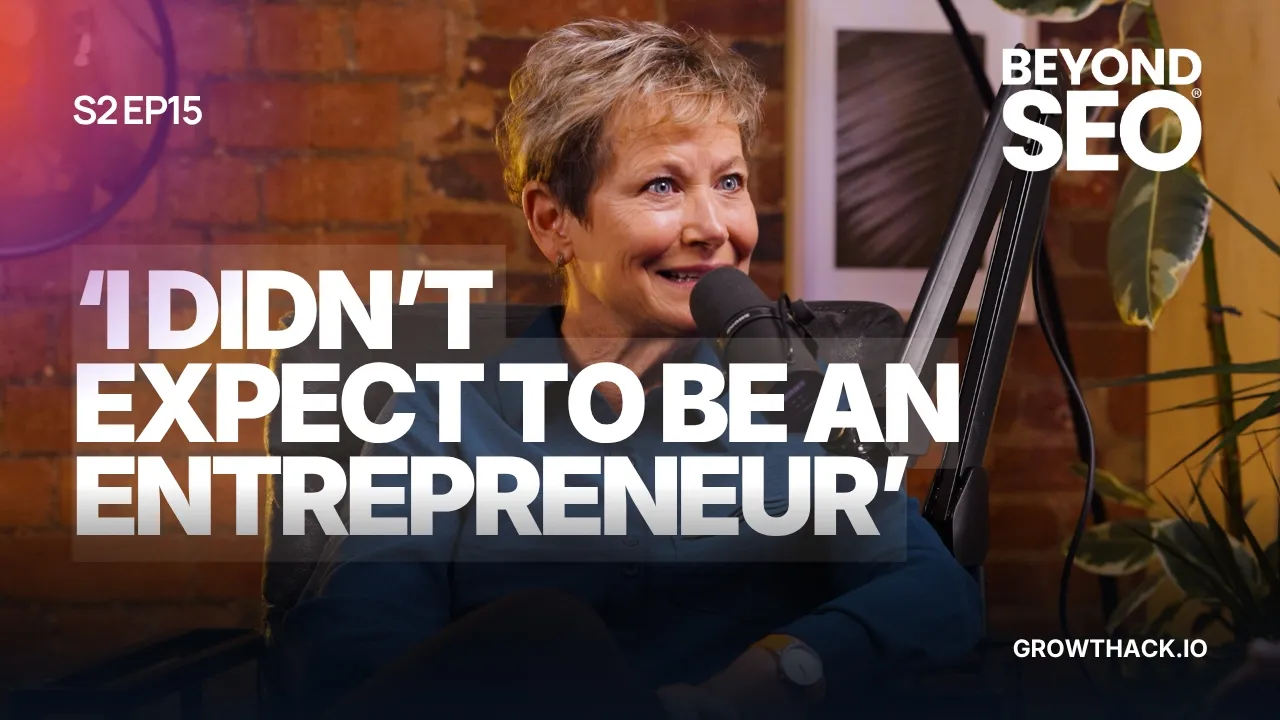
Beyond SEO® is back for season two, and this time we are going beyond marketing. I couldn't think of a better guest to open up the first episode than Susan Hallam MBE, founder of Hallam.
Watch Part 1 now on YouTube: https://youtu.be/KB9Vgf9fuQw
And here's a sneak peak into this season featuring guests such as The Cookie Dealer and the return of Ryan Jones (EP1).

Susan founded Hallam in 1999, the same year Google was finding its feet, back when the work was still called "web marketing".
She grew it from a one person consultancy into one of the UK's best-known digital agencies, and in 2025 she sold it into an employee ownership trust, which now holds the company on behalf of its staff.
She was also my first boss in the agency world, back in 2017.

We talked about her as a founder, the 26 year build and the unusual exit. It's also a chance for me to sit down with the person who shaped how I think about the work I do and learn what she would have done differently.

Nobody Is Born an Entrepreneur
"I think there's this myth that either you're an entrepreneur or you're not. I don't think people are necessarily born entrepreneurs."
Susan Hallam MBE, founder of Hallam
She came from a family of teachers. She was a senior lecturer in computing, then worked at British Telecom on their internet services and at Capital One on financial services. She was 38 when she founded the company, with two small children and a mortgage to pay, and she is clear that "that's not an unusual age".
If you believe founders are a type, you wait to feel like one. Susan did not. She spent years becoming good at something first, and the company followed from that.
Ten Years Being Solo
What followed was not a hockey stick.
"I worked essentially on my own for 10 years, and that's also really typical of small businesses to have that long, slow start, and then there was liftoff."
Only after that decade did the hiring happen, and then it happened quickly: five people, fifteen, twenty-five, forty-five.
A lot of people want to hear 12 months, 24 months, growth straight away.
10 years of consistency followed by a team built around you is a less exciting story and a far more common one. I put it to her in the episode that not many businesses last five years, and the data bears that out: of UK businesses born in 2019, 38.4% were still active five years later, according to ONS business demography. Twenty-six years is a different order of magnitude.
Ethical SEO
Susan's early positioning was a commercial decision rather than a moral pose.
"My whole business proposition was ethical SEO. So we never did the naughty stuff. We always did the right thing, and as a result, our clients never experienced a penalty."
In an era of link farms and manual penalties, that choice had a concrete pay-off: her clients never took one.
Her reading of the present moment is the line I keep coming back to.
"On the one hand, everything was different when I started the agency. On the other hand, there's nothing new under the sun."
The shortcuts have changed shape, not nature. Generate a pile of AI content and cheat your way to the top. Manufacture Reddit presence. She also mentioned agencies injecting prompts into the HTML.
Read the full article on the website >>
What She Would Have Done Differently
Asked what she would do differently, she did not reach for a tactic.
"I would certainly have decided to specialise sooner, to niche down."
She described the pull of interesting work, which she called "shiny, shiny": the United Nations, the Southbank Centre, Boots, Experian. Good clients, good work.
"In hindsight, I think if we had specialised down sooner, niched down into business to business, that would've given us superpowers. If we had been a niche specialist player, we would know the industry. We would be able to help our clients. That would've really transformed the agency."
Her point is that breadth has a cost which only shows up later: a specialist compounds what it knows about one industry, and a generalist starts fresh more often.
On hiring she was blunter and more cheerful: "My rule of thumb was to employ people smarter than I am."
Selling an Agency to the People Who Built It
The exit is the part most people will not have come across, and it was not a single event.
"I went through a partial MBO, a management buyout, where I sold some of my shares to the current directors of Hallam, but I retained shares. And then together we explored the opportunity of this thing called an employee ownership trust. The shares now are invested in the employees of the company. So the motivation now is that the people who work at Hallam own the company."
She had already ruled out outside investment, on the grounds that anyone putting cash into a business wants a route to take it back out, and that changes what you are optimising for.
In agency land the common exit is acquisition by another agency, which is a very different proposition for staff and clients. Susan is careful not to prescribe her route and says plainly that her path is not typical.
What an Employee Ownership Trust Costs Now
If the episode makes you curious, the numbers have moved since Susan sold.

EOT Structure from the Governance and Compliance Magazine (Chartered Governance Institute UK & Ireland)
For disposals to the trustees of an employee ownership trust made on or after 26 November 2025, 50% of the gain is treated as the seller's chargeable gain. The other half is not charged at that point: it is held over and deducted from the trustees' acquisition cost, so it falls due on a later disposal by the trustees. Business Asset Disposal Relief and Investors' Relief cannot be claimed alongside. Separately, for disposals on or after 30 October 2024, former owners and connected persons cannot retain control of the company after the sale, the trustees must be UK resident as a single body, and the trustees must take reasonable steps to ensure the price paid does not exceed market value.
None of that makes employee ownership a bad idea. It does mean the arithmetic you would run today is not the same when compared to most of 2025, so take proper advice before assuming the headline relief still applies.
Final Thoughts
She is honest about the cost of it, which is the part that rarely makes it onto LinkedIn. "It can be lonely as a business owner," she said, and "I think the phrase work-life balance is a myth".
What I took away was not the exit. It was that she spent ten years running a consultancy and getting good at it before there was a large team around her, and that the reflection on how things could have gone differently.
Part 2 goes deeper into scaling an agency, how a founder's role changes as the business grows, and what the future looks like for agencies and the people running them.
Watch the full episode of Beyond SEO® with Susan Hallam MBE to hear the whole conversation: https://youtu.be/KB9Vgf9fuQw


" width="0px"/></svg>)