
The Cookie Dealer Story
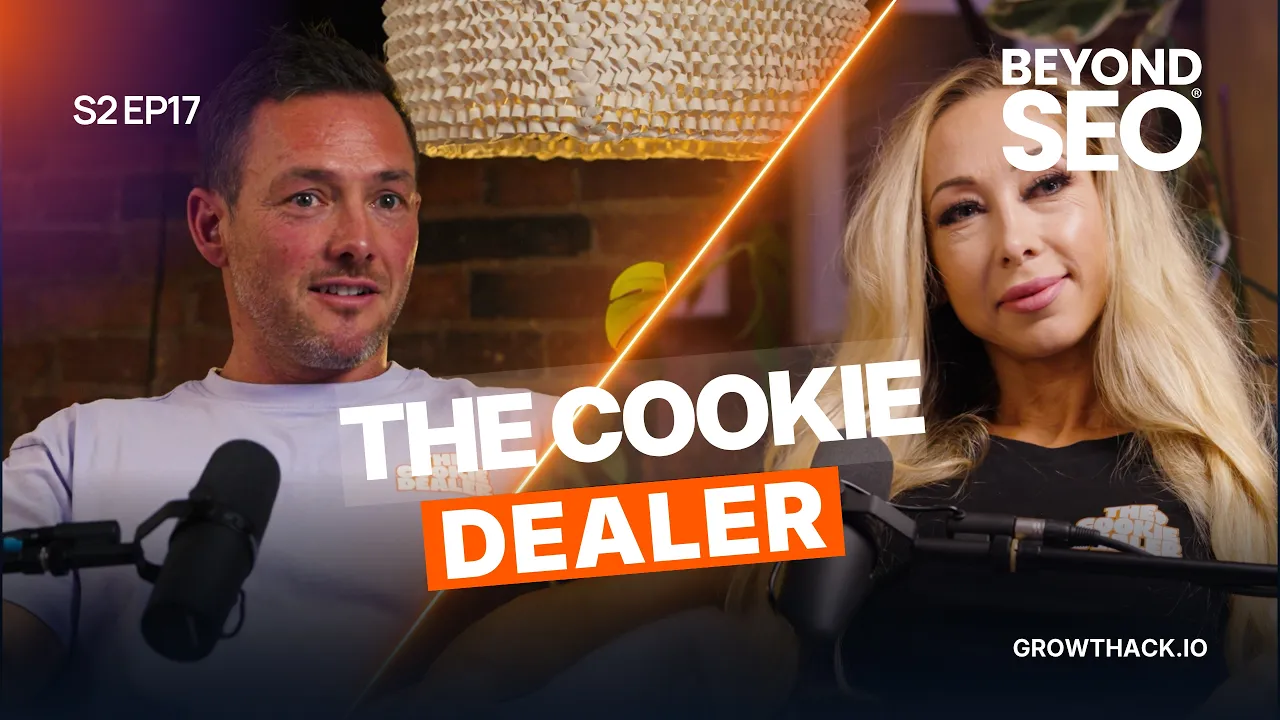
My conversation with David Sawyer and AGATE SAWYER, founders of The Cookie Dealer, on Beyond SEO®.
Watch it now on YouTube: https://youtu.be/CFfY3-7CxqU
Last episode was Susan Hallam on making herself redundant from the agency she built. This one is the same problem from the opposite end: two people who had to build the thing before they could step out of it.
What does "skin in the game" actually cost?
Is a product that's hard to make an advantage or a liability?
And what happens when the retailer who rejects you makes you?

Selling the house was the first act, not the last
The headline from this episode is that they sold their house for the business. The sequence is more interesting than that.
They sold it in 2017, before there was a business at all — put everything in a container and went travelling with no plan to come back. The cookie idea arrived in New York that December, on a freezing walk between food places, at Levain Bakery.
"It was like nothing I'd ever seen. Or ever tried."
Then it sat as a "what if" for two years while David took a job at a Mercedes dealership that he describes as the worst thing he has ever done, and quit. The idea only became a business because COVID grounded them.
The second house moment is the one that matters:
"Inadvertently ... our business became our house ... So it better, it better work."
They live at the bakery. The whole investment is one building. When I said that was skin in the game, Agate's line was better: "literally skin."
The rejection was the distribution strategy
This is the part other founders should study.
A retailer turned them down, and used their lack of a production facility as the reason. David posted about it on LinkedIn. A friend from his motor-industry days, Kenny, told him to put it on TikTok instead.
"I put the camera in the bakery and I just sat and I just told exactly what happened ... And it was a Friday afternoon, and then we went to pick our daughter up ... my phone started going ping ping ping ping ... by the time we'd picked her up, my battery had died."
Good Morning Britain got in touch. The Times and The Telegraph got in touch. And the comments filled up with people telling Aldi to pick it up.
Aldi UK picked it up.
On the numbers: David remembers that post at around two million views. Grocery Gazette's write-up of the Aldi listing puts the viral video at more than 1.7 million and credits the listing directly to social-media demand from shoppers, so the story checks out and the figure is close.
One detail worth keeping honest, because it changes what the win was: the Aldi launch ran as a Specialbuy at £2.99 a two-pack, stocked while supplies last. "Every single Aldi in the UK" is roughly a thousand stores, which is a genuinely national moment. It was not a permanent shelf.
That is the actual lesson. The viral post did not get them a listing. It got them a meeting, samples, a request to change the product, and a chance to prove they could make it at volume.
The moat that is also the single point of failure
Their product is hard to make. They had to design the production process around the cookie rather than the other way round, and they stood on the line for ten to fifteen hours when it went wrong.
"Our take on the cookie to make at scale, it turns out it's super, super difficult, which everybody says is a good thing."
The reference point they reach for is the Greggs pastry: a process nobody can easily copy, and therefore an asset.
That is the standard argument for a process moat, and David is right that it is real. What interests me is that he says it with a shrug — "which everybody says is a good thing" — because the people saying it are not the ones standing on the line at hour fourteen.
A process moat has a second edge. If you are the only ones who can make the thing, you are also the bottleneck: every new listing depends on your own capacity, and capacity is the hardest thing for a small business to buy. And if you solve that by handing the making to a partner so you can scale, the moat now sits inside somebody else's factory, on somebody else's priorities.
Both of those are true at once. The defensibility is genuine, it is just not free, and the bill arrives as operational risk rather than as a competitor.
The health bill arrived before the business was safe
Lockdown demand was the good problem. They worked 6am to 1am, six and a half days a week, just the two of them.
"We worked and worked till it made me ill."
A urine infection went untreated and turned into sepsis. Three months signed off. The business only survived that gap because they had taken on their first baker shortly before.
That is the sequence most founder stories leave out: the hire that looks like a cost is the thing that lets the company survive you being unavailable.
Four years on, it runs without them.
"We don't micromanage ... they're self-managing"
Which brings it back to Susan. She had to be deliberately removed from a company of 50-odd people. David and Agate got there at a far smaller scale, by accident, because one of them collapsed.
Final Thoughts
What I am taking from this one:
Being rejected in public is distribution, if you are willing to tell the story straight
Virality buys a meeting, not a listing
A process nobody can copy is a moat and a bottleneck, and you own both
Hire before you need to, because the thing you are insuring against is yourself
The through-line with last episode is that neither guest built a business that needed them. Susan did it on purpose over years. David and Agate did it because the alternative was not surviving the week.
"Never get too high, never get too low."
Watch the full episode of Beyond SEO® with David and Agate Sawyer of The Cookie Dealer: https://youtu.be/CFfY3-7CxqU


" width="0px"/></svg>)