

Most ecommerce brands are working hard
They're publishing content.
They're targeting keywords.
They're running technical audits.
They're chasing the latest AI SEO trends.
And yet many of them continue losing visibility to the same competitors year after year.
The reason is surprisingly simple.
They're focusing on the wrong things.
Over the last decade, I've worked with ecommerce brands ranging from niche retailers through to national businesses generating millions in online revenue. Across those campaigns, one pattern appears consistently.
The brands that outperform their competitors don't necessarily have bigger budgets or larger teams.
They simply focus on the foundations first.
In this article, I'll share the framework we use to help ecommerce brands improve visibility, increase revenue and reduce reliance on paid advertising.
The DCBAS Framework
When we think about organic growth, we use a framework called DCBAS.
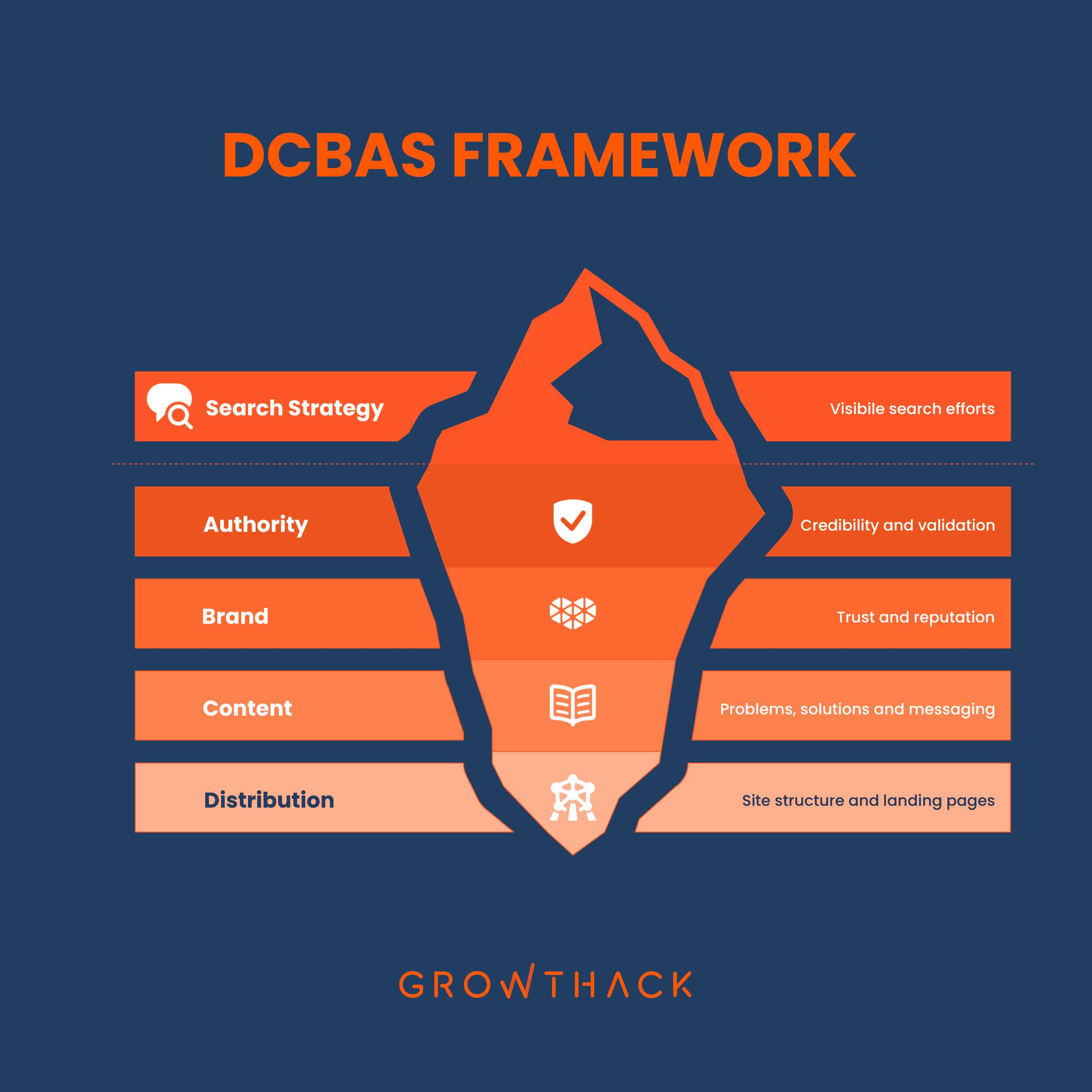
Each letter represents a layer of organic performance.
D — Distribution
How your website is structured and how your products are distributed across search.
C — Content
The quality, relevance and usefulness of your content.
B — Brand
How clearly buyers and search engines understand who you are.
A — Authority
The external trust signals supporting your brand.
S — Search Strategy
The SEO tactics, optimisation and planning that sit on top.
You can also watch me explain this in detail in a webinar with Lumar.
Most ecommerce businesses start with Search Strategy.
The best-performing brands build Distribution, Content, Brand and Authority first.
Search Strategy then amplifies what already exists.
Distribution: The Most Overlooked Ecommerce SEO Opportunity
The biggest opportunity we see across ecommerce websites is category depth.
Most online stores are far too shallow.
They have:
A broad category page
A few subcategories
Product pages
That's it.
The problem is that customers don't all search the same way.
Some search by product type.
Others search by use case.
Others search by feature, environment or problem.
If your website only reflects one way of searching, you're leaving revenue on the table.
The Manage At Home Example
One of the clearest examples comes from our work with Manage At Home.
They sell mobility and daily living aids for elderly and disabled users.
When we first became involved, many of their product categories were extremely broad.
Mobility scooters were grouped together.
Rollators were grouped together.
Wheelchair accessories were grouped together.
The issue wasn't the products.
The issue was the structure.
Customers weren't searching for "rollators."
They were searching for:
Lightweight rollators
Carbon fibre rollators
Indoor rollators
Travel rollators
Heavy-duty rollators
Four-wheel rollators
Three-wheel rollators
Each of these represented a different way customers viewed the same product category.
By expanding category depth and aligning the site structure with real customer behaviour, Manage At Home achieved a 320% increase in sales following their Shopify migration.
Think Through Customer Lenses
One useful way to think about category structure is through customer lenses.
Customers don't all look at products through the same lens.
A buyer may view a product by:
Size
Material
Colour
Use case
Location
Budget
Lifestyle
Problem being solved
Your site architecture should reflect these perspectives.
The easier it is for customers to find what they're looking for, the easier it becomes for search engines to understand your website.
The Wine Rack Example
Keyword tools don't always reveal the best opportunities.
Several years ago, I worked with a wine rack retailer.
Through conversations with the business, we discovered one of their most popular installation types was under-stairs wine racks.
Customers were actively asking for these products.
Yet there was no dedicated page targeting that use case.
Once a page was created around that specific installation type, it began attracting organic visibility that competitors weren't targeting.
The lesson is simple.
Your sales team, customer service team and existing customers often reveal opportunities that keyword tools miss entirely.
Content and Brand Must Work Together
The next area that separates leading ecommerce brands is the relationship between content and brand.
Google and AI search platforms need to understand:
Who you are
What you sell
Who you serve
Why you're different
Many ecommerce websites fail this test.
Their messaging is generic.
Their positioning is vague.
Their homepage could belong to almost any competitor in the market.
If search engines can't easily understand what makes your brand unique, why would they recommend you?
Why Your Homepage Matters More Than Ever
Traditionally, the homepage was viewed primarily as a navigation page.
Today, it's much more than that.
AI search platforms increasingly use homepage content to understand and describe brands.
We've seen examples where AI-generated answers directly reference homepage copy and metadata when explaining what a business does.
That means your homepage should clearly communicate:
Your audience
Your specialism
Your product range
Your experience
Your differentiators
The more specific you are, the easier it becomes for search engines and AI platforms to understand your brand.
Consistency Is Critical
One of the biggest mistakes brands make is inconsistency.
Their homepage says one thing.
Their category pages say another.
Their product pages tell a different story again.
AI systems now analyse websites holistically.
They don't look at a single page in isolation.
They look for consistency across:
Homepage content
Category pages
Product pages
Metadata
Navigation
About pages
The brands that perform best communicate the same message consistently across every touchpoint.
Authority: The Foundation That Competitors Can't Fake
The final piece of the puzzle is authority.
Authority consists of the signals that exist outside your own website.
This includes:
Backlinks
Brand mentions
Reviews
Press coverage
Citations
Industry recognition
These signals help search engines determine whether your brand deserves visibility.
And they're becoming even more important as AI search grows.
Why Reviews Have Become So Important
If I had to choose one authority signal for most ecommerce brands, it would be reviews.
Reviews are difficult to fake at scale.
They're generated by real customers.
They're visible to both search engines and buyers.
They're one of the strongest indicators of trust available online.
We've seen this first-hand with PassMeFast.
When we first started working with them, they had very few Google reviews.
Today, they have more than 1,500.
That increase in trust signals contributed significantly to improved visibility for highly competitive search terms.
Press Coverage Still Matters
Press coverage remains one of the most effective ways to build authority.
This doesn't always mean appearing in national publications.
Industry-specific publications are often equally valuable.
For example, one strategy used by The Brick Tile Company involves supplying high-quality imagery that journalists can use in editorial features.
This has resulted in coverage across highly relevant publications and strengthened the brand's authority over time.
The key is becoming part of the wider conversation in your industry.
Why Authority Matters Even More in AI Search
Traditional search engines largely relied on links and on-site signals.
AI search platforms pull information from a much broader ecosystem.
They evaluate:
Reviews
Forums
Articles
Editorial coverage
Product comparisons
Third-party mentions
The brands being discussed across multiple sources are significantly more likely to appear in AI-generated recommendations.
In many cases, AI systems trust third-party sources more than the brand itself.
That's why authority is becoming one of the strongest competitive advantages available.
The Real Difference Between the Top 1% and Everyone Else
The brands consistently winning in organic search aren't relying on SEO hacks.
They're not chasing every algorithm update.
They're not looking for shortcuts.
Instead, they've built:
Strong distribution
Useful content
Clear brand positioning
Genuine authority
Only then do they layer SEO strategy on top.
That's the difference.
And it's why they continue outperforming competitors year after year.
Final Thoughts
If you're struggling to generate meaningful revenue from SEO, don't start by looking for new tactics.
Start by examining your foundations.
Is your site architecture aligned with how customers search?
Does your content clearly communicate what makes your brand different?
Are you building authority outside your own website?
Because when distribution, content, brand and authority work together, SEO becomes significantly more effective.
That's how the top 1% of ecommerce brands continue to win.
And it's how you can start outperforming competitors too.



" width="0px"/></svg>)