

What does SEO actually mean for CMOs?
So, in this guide, we'll debunk some of these myths and discuss the realities of SEO. We'll also cover the obstacles you'll encounter if you try to create a strategy yourself and show you why it's best to hire consultants instead.
Case Study: Positioning for buyer-led growth
SEO involves optimising your site to generate high-quality traffic, improve search engine rankings and increase revenue.
The primary focus of SEO is to rank highly for search terms related to your business's products/services. Doing so drives more leads, generates sales, and builds brand awareness.
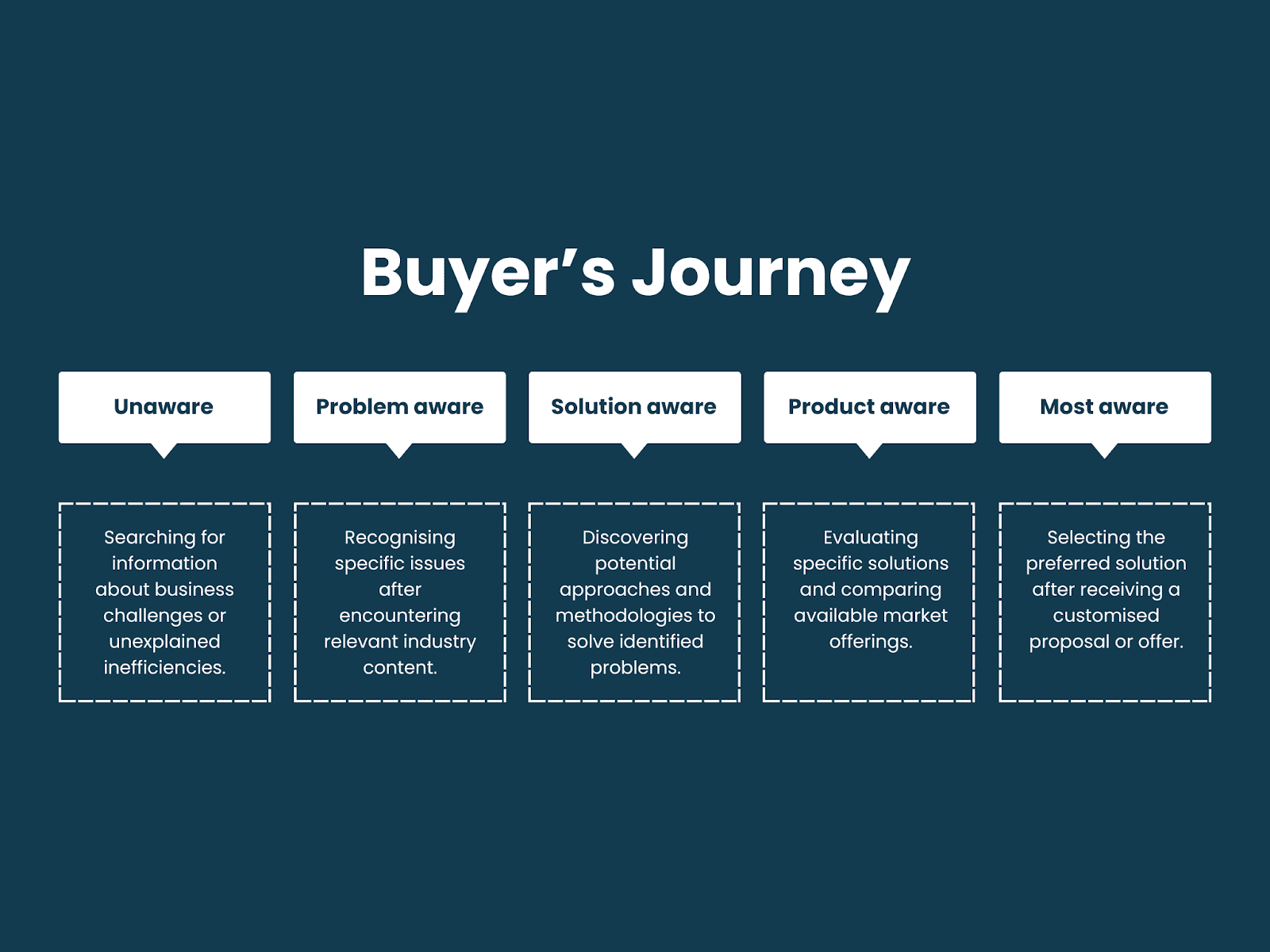
To achieve this, we create and execute an SEO strategy tailored to target users at each stage of the buyer's journey and ensure it's aligned with your broader digital marketing campaigns.
SEO is particularly important for B2B CMOs as it has a significant impact on brand visibility, customer acquisition, and overall revenue generation. In fact, it's the most used marketing tactic by B2B companies.
To give you an even better idea of why SEO is so important for CMOs in the B2B space, take a look at these stats:
66% of B2B buyers rely on organic search when researching products/services they plan to buy.
23% of B2B marketers say organic search is the most effective channel for driving revenue.
B2B buyers spend 27% of the buyer's journey using organic search.
B2B companies generate double the amount of revenue from organic search than any other marketing channel.
Generally, the most effective way to achieve SEO success is to hire experienced consultants like Growthack. We can assess your business's overall goals and craft an SEO strategy that helps you accomplish them.
SEO myths vs realities for CMOs
There are various myths about SEO and its processes. To help you better understand how it works and set your expectations, we're going to debunk a few of these misconceptions.
Myth | Reality | |
Timescales | One of the most common myths we come across is that SEO delivers instant results. | The reality is that SEO strategies take time to produce significant results. They require patience and persistence and are designed to achieve long-term, sustainable success. |
Cost | Another common myth among digital marketers is that SEO is a one-time investment that delivers results indefinitely. | In reality, SEO is an ongoing investment for CMOs as it requires continuous effort. It's not a case of simply creating a strategy and then leaving it in place. |
Rankings | There is a common misconception that the only real aim of SEO is to get your site ranking in the coveted top position of the organic search results pages. | While high rankings are beneficial, SEO objectives go far beyond this. The core goals are to drive relevant traffic to your site and turn that traffic into conversions. High rankings alone do not count as success. |
Content quality vs quantity | Content is the bedrock of any successful SEO strategy. However, some agencies focus on generating high volumes of content in an attempt to send positive signals to search engines. The issue with this is that quality is often sacrificed so that content can be pumped out at a rapid pace. | When it comes to SEO, quality is more important than quantity. If you focus on quantity, it can lead to repetitive, shallow content that fails to address search intent and doesn't engage your audience. |
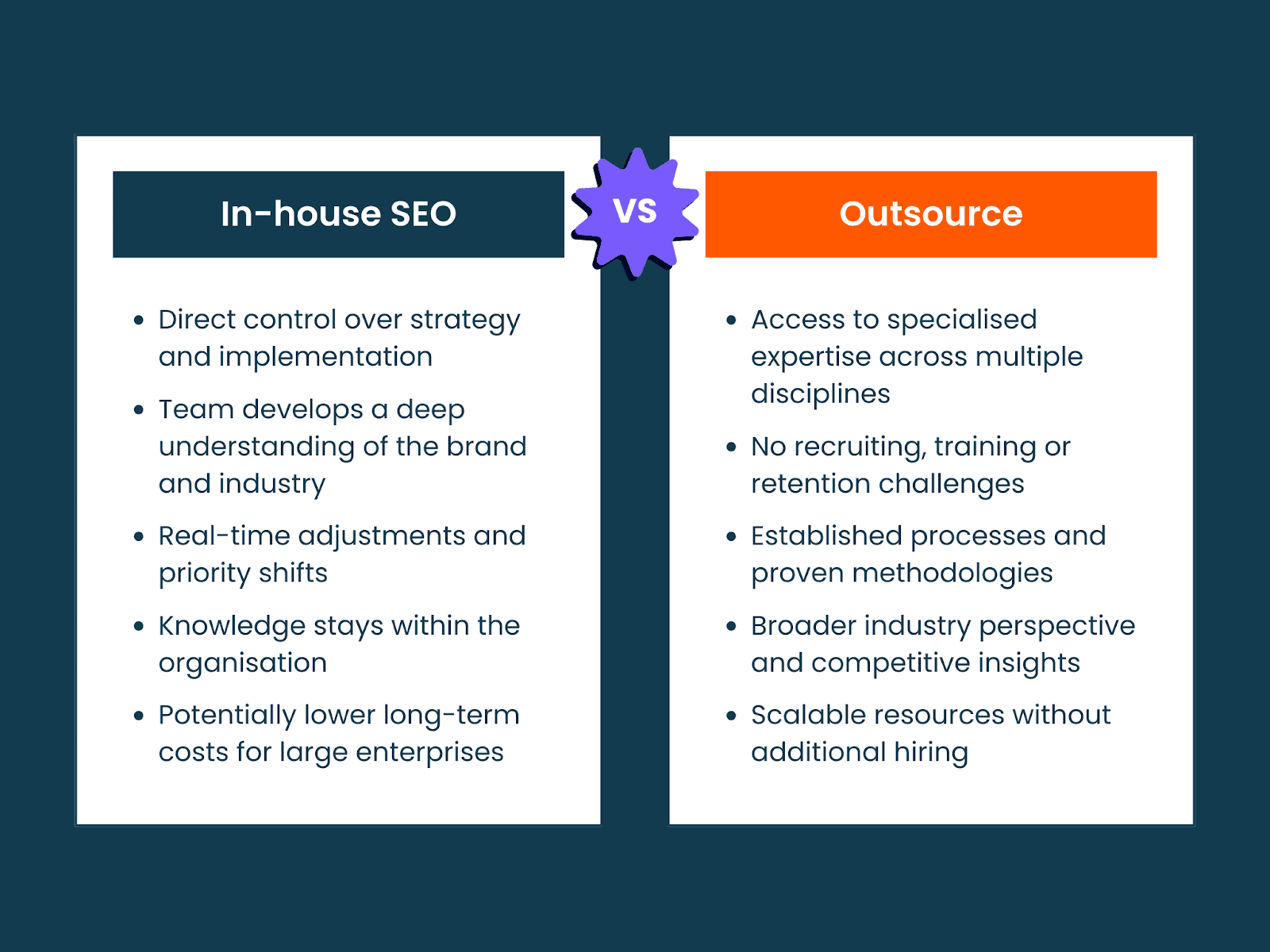
In-house vs outsourced SEO | The final myth we want to address is that keeping your SEO operations in-house is always more cost-effective than outsourcing them. | In fact, it's usually much more cost-effective to outsource your SEO operations to a consultant. |
Here are three reasons SEO is a long-term process
Building authority: The authority of a website has a big impact on its search engine rankings. To build authority, we use strategies like creating high-quality, authoritative content. Establishing authority is a gradual process, especially for new sites or sites that haven't yet built user trust by publishing authoritative content.
Competition: The competitiveness of your niche also has a big impact on how quickly you see results. If your brand is competing against established sites with strong SEO practices, it can take a significant amount of time to gain traction in the search engine results pages.
Search engine indexing: When new content is published on a site, it doesn't appear in search engine results immediately. First, search engine bots need to crawl and index the pages, which can take a long time. To make it easier for bots to crawl and index your site, agencies like ours use technical SEO to improve your site's architecture, which is a relatively gradual process.
These are some of the ways we ensures your content is of the highest quality:
We conduct thorough keyword research to identify topics that are relevant to your audience.
We create valuable content that targets these keywords and addresses your users' interests, needs, and pain points. Our content is designed for users first and search engines second.
We include insights and solutions in your content that can't be found elsewhere. This helps to establish your brand as a voice of authority within your niche.
We create content that demonstrates E-E-A-T (Experience, Expertise, Authoritativeness, and Trustworthiness). This is an important component of Google's Search Quality Evaluator Guidelines (SQEG) and demonstrating E-E-A-T gives your site a boost in the search results pages.
We enhance engagement and readability by using clear headings and subheadings and by breaking up walls of text with bullet points. We also design your content so that it has a logical flow of information, which is important for both users and search engines.
We incorporate target keywords naturally into the content.
We optimise titles and meta descriptions.
We incorporate relevant CTAs and internal links strategically to increase your conversion rates.
In-house vs outsourced SEO
4 Challenges Of Implementing SEO For CMOs
As mentioned, SEO is a complex process that requires plenty of time and resources. It's not easy to build an effective strategy that engages users and wins favour from search engines.
As a CMO, there are several key challenges you'll face if you decide to handle your brand's SEO yourself. Let's take a look at them.
1. Integrating SEO with your other marketing strategies
SEO shouldn't be an isolated marketing channel. Instead, it needs to be integrated into your broader marketing strategy. This can often be a challenge for CMOs, especially if they have little SEO experience.
However, integration is important as it prevents a fragmented marketing approach in which the various channels (SEO, email, social media, paid advertising) don't align.
This is an issue because users interact with your brand across multiple touchpoints, which means consistency is key.
If you choose to outsource your SEO, you'll need to collaborate with your consultant to ensure integration. This means that:
Your brand messaging is consistent across all of your marketing channels.
The consultant's SEO content is designed to be repurposed across other channels like social media.
Your SEO strategy targets the same audience segments as your other marketing strategies.
Consistent messaging across your marketing channels improves user experience and brand awareness, leading to increased conversions and enhanced credibility.
2. Performance data analysis
Tracking and analysing performance is a fundamental part of any successful SEO campaign. Yet, if you lack SEO experience, this can present a big challenge.
To track your campaign's performance data effectively, you'll need to use tools like Semrush, Ahrefs, Google Analytics, and Google Search Console to analyse metrics like:
Bounce rate
Conversion rate
Click-through rate (CTR)
Organic traffic
Keyword rankings
Leads generated
If you've never done this before, it can be very confusing to work out how your campaign is performing. As a result, you'll be unable to identify the areas of your strategy that are working and those that need improvement.
Our consultants provide clients with regular performance reports that clearly demonstrate the progress of your campaign.
We include data on all of the important metrics you need and give you insights into how we're achieving success for your business. This means performance data analysis will be one less challenge to worry about.
3. Technical SEO
Technical SEO is vital for improving the performance of your site and enhancing user experience. It includes a wide range of complex processes that are difficult to execute, which means you'll require an expert with lots of experience to get it right.
To demonstrate how complex it is, here are just some of the things involved in technical SEO:
Conducting technical SEO audits of your site to identify any issues.
Optimising for Core Web Vitals to ensure your site provides a great user experience.
Improving site speed with tactics like compressing images and minifying JavaScript and CSS files.
Implementing responsive designs to ensure mobile-friendliness.
Fixing crawling and indexation issues.
Fixing broken links, 404 errors, and setting up redirects.
Optimising URL structure.
Adding schema markup to enhance rich snippets.
Optimising your internal linking structure.
Addressing security issues like a lack of SSL certification.
As you can see, there's a lot involved, and a beginner simply can't handle these processes.
At Growthack, we provide advanced technical SEO services that ensure your site is fully optimised for the best possible user experience. We take care of everything, from indexation issues to web migrations, so users and crawlers can navigate your site with ease.
4. Staying ahead of competitors
As with your other marketing channels, SEO involves using various strategies to get ahead of your competitors and stay there.
To maintain a competitive edge, your strategy needs to be adjusted consistently based on analyses of competing strategies—which requires an expert. If you fail to keep up with your competitors, you'll lose out on qualified leads and sales.
Our consultants are highly experienced in analysing our clients' competitors and utilising the data to enhance their campaigns. This involves:
Using SEO tools to identify your direct and indirect competitors.
Analysing the structure, design, and content of their sites.
Identifying the keywords your competitors are targeting that are driving traffic to their sites.
Evaluating the types of content that are the most successful for your competitors.
Conducting a keyword and content gap analysis to find relevant topics your competitor has missed or topics that are currently missing from your strategy.
Analysing the technical SEO of competitor sites to identify areas for improvement on your site.
We then take all of this information and feed it back into your campaign. This helps us boost your traffic and rankings and ensures you stay ahead of your competitors. This means outranking them in the search results, attracting more organic traffic than them, and getting leads to buy your products/services instead of theirs.
What unethical SEO practices should CMOs be aware of when hiring an agency?
When hiring an agency, CMOs should avoid those that use unethical practices (known as black hat SEO tactics) to manipulate search engine algorithms.
These tactics can sometimes deliver fast results but they aren't sustainable, and they run the risk of incurring Google penalties.
Some of the most common black hat tactics to look out for include:
Keyword stuffing.
Buying backlinks from link farms.
Using redirects to send users to a different page than the one they clicked on.
Using private blog networks (PBNs) for link-building.
Displaying different content to search engine bots than the content displayed to users, which is known as cloaking.
How will Google's SGE affect SEO?
Google's SGE (known as AI Overviews) is already having a big impact on SEO. Many sites have noticed a decrease in organic traffic and visibility since it was introduced. This is because SGE results appear at the top of the search results pages and are designed to answer user queries without them having to scroll down and click on other results.
Agencies like ours are implementing various strategies to combat the negative effects of SGE like targeting longer-tail keywords and focusing on E-E-A-T even more than usual. However, SGE will continue to be a challenge that SEO agencies will have to overcome.
Final Thoughts
There are many myths about SEO that circulate among CMOs. Some think it's cheaper to keep it in-house rather than outsource it. Others believe the results are immediate instead of long-term.
While neither of these assertions is true, one thing certainly is—SEO is a complicated process that requires continuous effort.



" width="0px"/></svg>)